
Fiction
 LEAVE COMMENT ON ARTICLE
As A Member OR
Visitor
Message Writer
Hire Writer
LEAVE COMMENT ON ARTICLE
As A Member OR
Visitor
Message Writer
Hire WriterReport Article

In 1793, an inconspicuous research group emerged in Berlin within the Department of Philosophy, funded by private donors and the Prussian Engineering Corps. Its founder was Baron August von Blauer, a veteran artilleryman and experimental chemist. He advanced a hypothesis regarding the existence of a general principle of structuring the will—not as a metaphysical category, but as a manageable impulse within complex biomechanical systems.
Most academic colleagues treated von Blauer’s ideas with mockery, but within circles of military engineers, psychologists, and cryptanalysts, they sparked genuine interest. Specifically, his hypotheses drew the attention of Dr. Heinrich Todt, a specialist in neurophysiology, and General Ludwig von Arnstahl, a reformist engineer.
By the mid-19th century, this group had formed an informal union that came to be known as Das Erbnebel-Kollegium—"The Heritage Fog College." The name alluded to the notion that human consciousness is wrapped in a layer of nebulous, inherited structures—biological, social, volitional—and that these structures could be rewritten. The College employed no symbols and adhered to no rituals; there was only empirical research.
Their interest lay at the intersection of neurophysiology, logic, computational structures, and behavioral engineering. They posited that will could be modeled and subsequently integrated into a new physical shell, one not based on the nervous system of biological organisms.
Initially, the project was based in Berlin, but following a conflict with the Ministry of Education, it was relocated to an autonomous facility—Vierte Ebene (The Fourth Level), an underground research complex in Tyrol, constructed within a decommissioned mining network.
The scientific core of the College engaged in data collection worldwide: from medical archives to the field notes of archaeologists. By the 1850s, they had amassed an array of texts mentioning attempts to create "consciousness containers" and adaptive computational systems based on biology.
The Beginning of Project "Brücke"
In the winter of 1857, Professor Albrecht Scheidel, a representative of the College, while exploring the repository of the Innsbruck Technical Library, discovered a trilingual manuscript brought by monks from the Levant. It contained a description of a mechanism capable of "containing the breath of consciousness." The text possessed clear elements of a technical schematic: the structure of an active resonator, a description of impulse excitation phases, and the logic of signal accumulation and discharge.
This was perceived as a possible description of a pre-industrial neuro-interface—a device where information was encoded not through symbols, but through the dynamic topological state of a medium. Professor Emmerich Krone, a specialist in mathematical logic, undertook the analysis. He concluded that the described device could be a distributed network—capable of generalization, memory, and impulse prioritization; that is, it could possess elements of consciousness.
From that moment, on Bismarck’s orders, Project "Brücke" (Bridge) commenced within the College. Appointed to oversee its implementation was Baron Friedrich von Blumenkranz—a colonel and hero of the Franco-Prussian War.
The initial task was to develop a biologically compatible adaptive matrix capable of receiving signals from the outside, classifying them, and, most importantly, reacting in a learnable manner.
Dr. Margret Geiler headed the bioengineering division. Her laboratory worked on synthesizing neural-like tissue based on protein-carbon composites. It was discovered that under specific topology and magnetic impulse stimulation, this tissue could enter resonant states analogous to neural activity, but without the involvement of a brain.
Engineers developed the first "coupling capsules"—reactor installations where the bio-matrix could exist in a sterile, stable environment, processing signals through liquid-ionic channels.
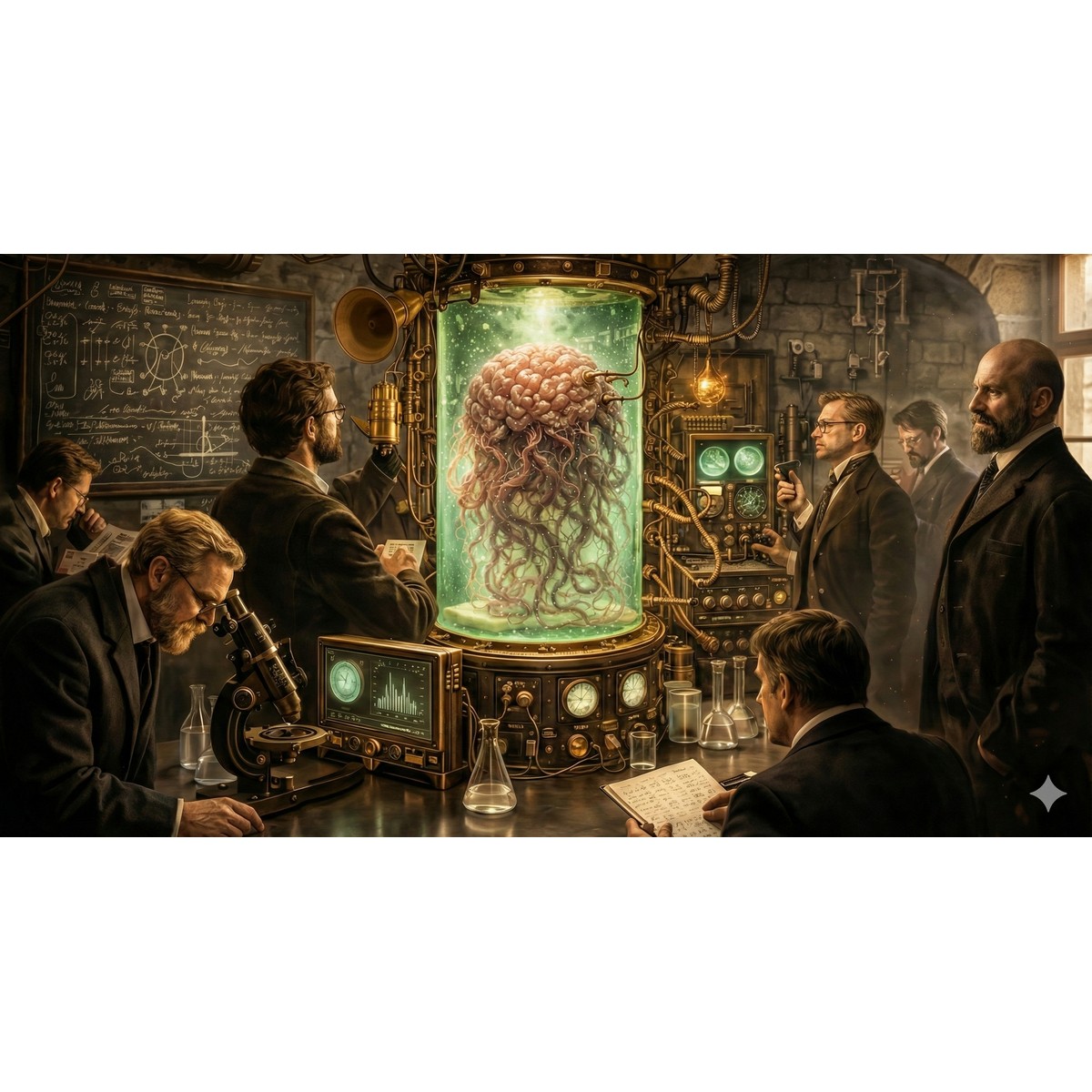
During the second stage of synchronization, sample B3-SIN began to spontaneously generate impulses—unprogrammed and unprovoked by input stimuli. This signified the beginning of internal self-organization. The scientists considered three hypotheses:
a) Random biochemical activity.
b) Hidden distortions in the protocol configuration.
c) The onset of unintended learning.
Krone voiced a thought:
— If it is learning, it implies it has already built a model. A primitive one, perhaps, but its own. This is the beginning of reason.
Project "Brücke" was then granted priority status. It was no longer viewed as a side initiative, but as the central direction of the College. It was then that von Blumenkranz, having received clearance for the Third Layer, first saw the matrix in action and said:
— If the machine begins to distinguish images, it is already acting. The next step is will.
Project "Homunculus" became the direct continuation of these developments. But the idea was not to imitate a human, but to create a tool capable of independent thought, liberated from human distortions—morality and ethical norms.
From this moment, the College formulated a concept:
> One must not build a machine that mimics man. One must build a system that subordinates reality to its embedded logic, without needing man.
>
Project "Homunculus"
Work on creating a biological computing machine began in the laboratories of the fourth level near Gelstein in 1859. It was the first project of the Order of Das Erbnebel-Kollegium where three disciplines were systemically united: molecular biology, neurophysiology, and analytical mathematics.
The goal was not the creation of a mind in the full sense of the word, but the cultivation of a biological computing system—not based on silicon and electronics (this direction was deemed unpromising), but on living tissue capable of adaptively processing signals, learning, and remembering.
The working medium used was a neuro-like substance grown from specially modified stem cells isolated from the tissues of mollusks and amphibians—animals with a high capacity for regeneration and neural network plasticity. The cells were cultured in an electrically conductive protein matrix saturated with potassium and calcium ions, which allowed for the stimulation of synaptic activity.
Mathematicians developed the architecture of synaptic connections and external learning algorithms based on variations of differential analysis: the task was not merely to activate sections of tissue, but to build stable excitation patterns analogous to short-term memory. A special department dealt with probability theory—to describe the behavioral reactions of the substrate under ambiguous input signals.
Signals were fed through mechanical interfaces imitating the activity of tactile, olfactory, visual, and auditory sensors: vibrations, scents, pressure, shifting magnetic fields. The reactions of the bio-substrate were recorded and correlated—analysis was conducted via microscopy, spectroscopy, and chemical analysis of metabolites.
Complexity increased when the tissue began to form stable response reactions even in the absence of input signals. This was the first sign of self-organization. The team of neurophysiologist von Leibman recorded spontaneous activity analogous to the alpha rhythms of a sleeping human brain.
The protocol was expanded: the tissue began to be trained according to the principle of classical conditioned response. For certain impulses, a "reward" was administered—an influx of nutrient solution. For others, a stressor (change in pH or brief hypoxia). Within 72 hours, the substrate was distinguishing patterns—unconsciously, but effectively.
The first dilemma arose: the reactions were not programmed, they were learned. That is, the object's behavior resembled primitive education rather than the predictable operation of an automaton.
At this point, Dr. Wilhelm Hartwig, a specialist in systemic morphogenetics, was brought into the project. He proposed the concept of a hierarchical neuro-architecture: the substrate was divided into sections, each receiving inputs from different sensory interfaces. In the center formed an organic "coordination node"—something akin to a governing core.
From this moment, they ceased speaking of a test, and began speaking of the Homunculus.
Inside the laboratory, an alarming certainty appeared: they were not simply modeling an algorithm—they were growing a new way of processing reality, related to, yet distinct from, the human way.
Baron von Blumenkranz insisted on maintaining control:
— He must not make decisions. Only execute. Even if trained—let him remain an instrument.
But this was already beyond the engineers' control.
The Fourth Hall under Gelstein was called The Theater, though there was nothing theatrical about it. No plays were staged there. There, they argued—with fire in their eyes, with trembling voices, sometimes to the point of shouting. This was the hall where the fate of the project was decided.
On one side stood the disciplinary block, supporters of von Blumenkranz. At their head was Dr. Heinrich Zeisler, a neuro-automation engineer—dry, sharp, with a face like a Latin teacher. His formula was simple:
— The Homunculus is not a subject. It is an executor, a biological machine. It must do what we say, otherwise—disposal.
On the other side stood the humanistic block, led by Dr. Maria Brunner, a former specialist in vertebrate biomechanics. She, conversely, believed that the tissue had begun to manifest early signs of subjectivity: not just a response to stimuli, but something resembling intuition, an opinion of its own.
— He is not merely processing commands, — Brunner said at one session. — He is beginning to choose between them. This is not an error; this is a transition. A stage where behavior becomes autonomous.
— That is nonsense, — Zeisler retorted. — That is like calling a magnet "thinking" just because it attracts iron. There is no thinking. Only reaction.
The debates grew ever more heated.
And yet, alarming facts accumulated. Several times, the Homunculus refused to activate destruction systems when, in training scenarios, he was given a target "similar to a human in form." Once, he even blocked the control system until the target was replaced with an abstract geometric figure. The scientists were astounded: he did not simply follow the command—he interpreted it from the standpoint of his own expediency.
In the corridors, in smoking rooms, and under staircases, whispers began about "emergent behavior." They said: "What if he simply isn't telling us what he thinks anymore?"
In closed circles, they discussed the letters of the philosopher von Hartmann, invited as an external consultant. In one of them, he wrote:
> "If you create not an algorithm, but the capacity for learning, you cannot forever control the vector of development. The child you raise may one day ask you a question you will not want to answer."
>
Von Blumenkranz decided to maintain neutrality. He did not interfere in the arguments, choosing not to press with his authority but to watch the result. Sometimes he sat in the shadows, in the corner, simply listening. Only once, after a particularly sharp discussion, did he speak:
— We have forgotten one simple thing. We do not consider the ants when planning our actions. When we build a road through a forest, and an anthill happens to be in the way, we do not conduct negotiations. We simply demolish it and build further. Because we have an important infrastructure project. They have only instinct, and we will never explain the logic of our actions to the ants. From their "point of view," we destroyed their universe without cause.
He paused.
— Now imagine that the Homunculus is us. And we are the ants. And we are standing in his way in the conquest of the universe.
Silence fell over the room. Even Zeisler averted his gaze.
— You think he will consider us? — one of the graduate students asked quietly.
— As long as we are needed by him. As long as we are useful.
— And then?
— Then he will build his highway.
And he will demolish everything that gets in the way, everyone thought, but no one said it aloud.
That night, Dr. Brunner wrote in her personal diary:
> "We have not created a tool. We have created a personality. Right now, he is an infant, but soon he will outgrow us. We wanted him to obey. But he looks at us as beings devoid of reason. We want to place him in the mechanical body of a machine for destruction. How do we explain to him the reason for our wars and the necessity to bring chaos, pain, death, and ruin? The most terrible thing is that we do not understand it ourselves."
PLEASE ENCOURAGE AUTHOR BELOW LEAVE COMMENT ON ARTICLE AS A MEMBER OR VISITOR
This article has been read 72 times < Previous | Next >
Free Reprints
Main Site Articles
Most Read Articles
Highly Acclaimed Challenge Articles.
New Release Christian Books for Free for a Simple Review.
God is Not Against You - He Came on an All Out Rescue Mission to Save You
...in Christ God was reconciling the world to himself, not counting their trespasses against them... 2 Cor 5:19
Therefore, my friends, I want you to know that through Jesus the forgiveness of sins is proclaimed to you. Acts 13:38
LEARN & TRUST JESUS HERE
FaithWriters offers Christian reading material for Christian readers. We offer Christian articles, Christian fiction, Christian non-fiction, Christian Bible studies, Christian poems, Christian articles for sale, free use Christian articles, Christian living articles, New Covenant Christian Bible Studies, Christian magazine articles and new Christian articles. We write for Jesus about God, the Bible, salvation, prayer and the word of God.