
Fiction
 LEAVE COMMENT ON ARTICLE
As A Member OR
Visitor
Message Writer
Hire Writer
LEAVE COMMENT ON ARTICLE
As A Member OR
Visitor
Message Writer
Hire WriterReport Article

Mood:
Die Apokalyptischen Reiter - Wir reiten
The Odesa port had been buzzing since early morning.
Port cranes released clouds of steam, pivoting over the holds. Tugboats puffed at the berths. From the depths of the ships came the rumble of crates, the clank of chains, shouts, and commands in various languages. Carts rolled over cobblestones strewn with straw and coal dust. Heavy dray horses pulled wagons loaded with grain, sacks, crates, and barrels. The air was thick—as if kneaded from fuel oil, coal dust, human sweat, and hot metal.
The port lived like an organism—it thundered, breathed, moved, and grew tired.
Standing apart, slightly removed from the main wharves, was the ancient building of the French Trade Representation. Stone, with a weathered flag on the pole, peeling stucco, and the coat of arms of a steamship company over the entrance. Here, cargoes were accepted, contracts signed, and paperwork processed for passengers bound for the south—to North Africa, to the ports of Morocco, Algiers, Tunis.
Inside, it was cool. Dark wood floors, silence, the smell of coffee, ink, and sea moisture. Secretaries with papers, fountain pens, soft French exchanges drifting through doors and over partitions. Everything here breathed order and neutrality.
Captain Shevchenko—tall, reserved, in the uniform of the Hetmanate Coast Guard—climbed the stairs and stopped at a door with a plaque:
Départements de douane et transit / Viddil perevirok
He reached for the handle when he heard footsteps behind him.
A man was walking from the end of the corridor—in civilian clothes, yet too strict. A dark jacket tapered at the waist, straight trousers, a fashionable soft hat. He was clean-shaven, restrained, his movements honed, his gaze attentive. The typical bearing of a combat officer who had taken off his uniform but not the habit of command.
Shevchenko immediately remembered the face. Golitsyn.
Their eyes met. Everything became clear without words.
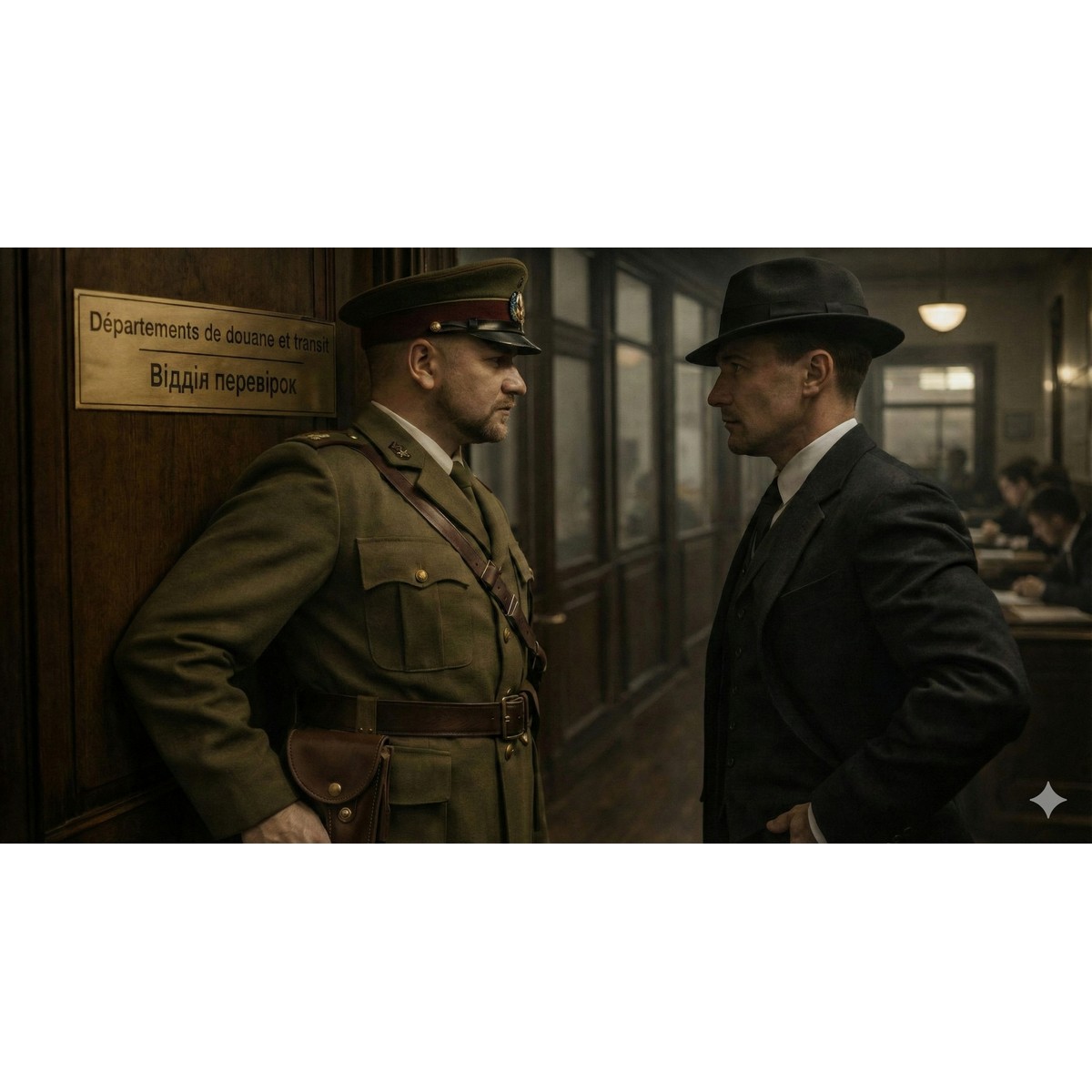
"Allow me?" Golitsyn spoke politely, with a slight shadow of superiority.
"Please," Shevchenko didn't flinch. "But I am the one making the inquiries."
"I am not sure you are authorized to obstruct me," Golitsyn said softly. "We are speaking of a vessel departing into international waters."
"We are on Rusyn territory," Shevchenko replied calmly. "Which means this is our jurisdiction."
"Ah, yes... borders, independence... jurisdiction," Golitsyn smirked slightly. "I am interested only in the route of a single ship."
"I respect the neutrality of this institution," said Shevchenko. "But I do not respect the Moksan manner of interfering in other people's affairs."
"We are not interfering," Golitsyn said firmly. "We are insisting on our right."
Silence hung in the air.
"Yussonivka?" Golitsyn asked quietly, narrowing his eyes.
"That happened," Shevchenko replied calmly.
"71st Dragoons. We stood at the bridge then. The regimental artillery got stuck."
"Fifty-fourth Infantry," Shevchenko threw back quietly. "We held that crossing."
Both fell silent. The tension thickened, like the air before a thunderstorm. For a split second, both reached for their weapons—mechanically, like soldiers.
Shevchenko—to the clasp of his holster.
Golitsyn—to the inside pocket of his jacket.
Their eyes met. Pupils dilated. Both froze. Bodies like springs. One movement away from disaster.
At that moment, a young woman passed them—a secretary with a stack of documents. Her heels clicked on the parquet. The sound broke the tension like a breath extinguishing a match.
Golitsyn stepped aside. Shevchenko slightly relaxed his shoulders.
They stood in silence a little longer. But now the silence was different—taut, ready to snap.
"Still ready to kill each other," said Golitsyn.
"Ready," confirmed Shevchenko. "Because we haven't forgotten. Because we haven't forgiven. The war still lives in us."
"And we won't forgive," Golitsyn nodded. "That war was too terrible."
"Too many of ours went down."
He shifted his gaze to the window, beyond which the port clamored.
"But if we snap—that is exactly what they are waiting for. All those politicians. Newspapermen. Diplomats."
"Any spark—and a new slaughter begins," said Golitsyn. "And all because of pride. Mine. Yours. Ours collectively."
"For the sake of the children," said Shevchenko. "For the sake of their future."
"For the sake of not bequeathing this war to them as an inheritance," added Golitsyn.
They fell silent. Without friendship. Without peace. Just two men, too tired of killing.
"Before, it was marches, uniforms, fanfares," Golitsyn said quietly. "You hear nothing, reason is obscured by discipline and orders."
"And then—the slaughter," added Shevchenko. "You see your friend's head blown off. The very one with whom you shared your last cigarette. You see rotting bodies. You see cities, blooming just yesterday—in ruins today."
"And then you have a son," Golitsyn paused for a moment. "And you realize: you don't want him to go through this."
He sighed heavily, looked away, and spoke almost to himself:
"Back then in the Khanate, everyone seemed to have gone mad. The newspapers kept harping on about a 'small victorious war.' The Khan issued a manifesto on the reunification of lands and the restoration of historical justice. People walked the streets as if under hypnosis—with little flags, with songs, rapture on every face. Even those who yesterday had kept a disapproving silence suddenly began speaking of duty and a great mission. Everyone wanted this war. could anyone back then have imagined how it would all end?"
Shevchenko nodded, looking aside.
"We were no better. We saw it all. We saw the militaristic fumes taking hold of the neighboring country. But instead of preparing for war and teaching young soldiers to fight, we taught them to march in parades and polish buttons. And the politicians spoke of an 'unprecedentedly low probability' of a new war."
He raised his eyes.
"And then—the world collapsed. Early winter morning. Explosions. Columns of advancing troops. The harvest of death."
"Five years ago, I would have been ready to tear your throat out," Shevchenko pronounced.
"I am still ready," said Golitsyn. "Only now I know what comes after that."
"And after that—patriotic pathos again, hatred in newspaper articles, and calls to answer the provocation harshly. Then mobilization. Mass graves. Amputees without legs begging on the street."
"And tears again. And burnt houses again. And generals with pointers in front of maps again."
"We won't let it happen. Not to them. Not to ourselves."
He looked at Golitsyn.
"Not because we are friends. But because we have remained, at least a little bit, human."
"Hatred will live in us forever," said Golitsyn. "But perhaps simply living side by side without killing—that is all we are capable of."
"That is already a lot."
Silence hung. No longer hostile. Just the silence of two people who no longer want to kill.
"Let's go," said Shevchenko. "Without positions. Without flags. Just as people."
"Agreed," nodded Golitsyn. "There is no sense in grasping for swords."
They entered the office simultaneously.
Not friends. Not enemies.
Just two men who had seen death and learned the value of life.
And who understood: sometimes holding back is harder than pulling the trigger.
PLEASE ENCOURAGE AUTHOR BELOW LEAVE COMMENT ON ARTICLE AS A MEMBER OR VISITOR
This article has been read 69 times < Previous | Next >
Free Reprints
Main Site Articles
Most Read Articles
Highly Acclaimed Challenge Articles.
New Release Christian Books for Free for a Simple Review.
God is Not Against You - He Came on an All Out Rescue Mission to Save You
...in Christ God was reconciling the world to himself, not counting their trespasses against them... 2 Cor 5:19
Therefore, my friends, I want you to know that through Jesus the forgiveness of sins is proclaimed to you. Acts 13:38
LEARN & TRUST JESUS HERE
FaithWriters offers Christian reading material for Christian readers. We offer Christian articles, Christian fiction, Christian non-fiction, Christian Bible studies, Christian poems, Christian articles for sale, free use Christian articles, Christian living articles, New Covenant Christian Bible Studies, Christian magazine articles and new Christian articles. We write for Jesus about God, the Bible, salvation, prayer and the word of God.