
Fiction
 LEAVE COMMENT ON ARTICLE
As A Member OR
Visitor
Message Writer
Hire Writer
LEAVE COMMENT ON ARTICLE
As A Member OR
Visitor
Message Writer
Hire WriterReport Article

Captain Shevchenko’s recollections of the first months of the war, compiled from his diaries written during the battles on the Southern Front.
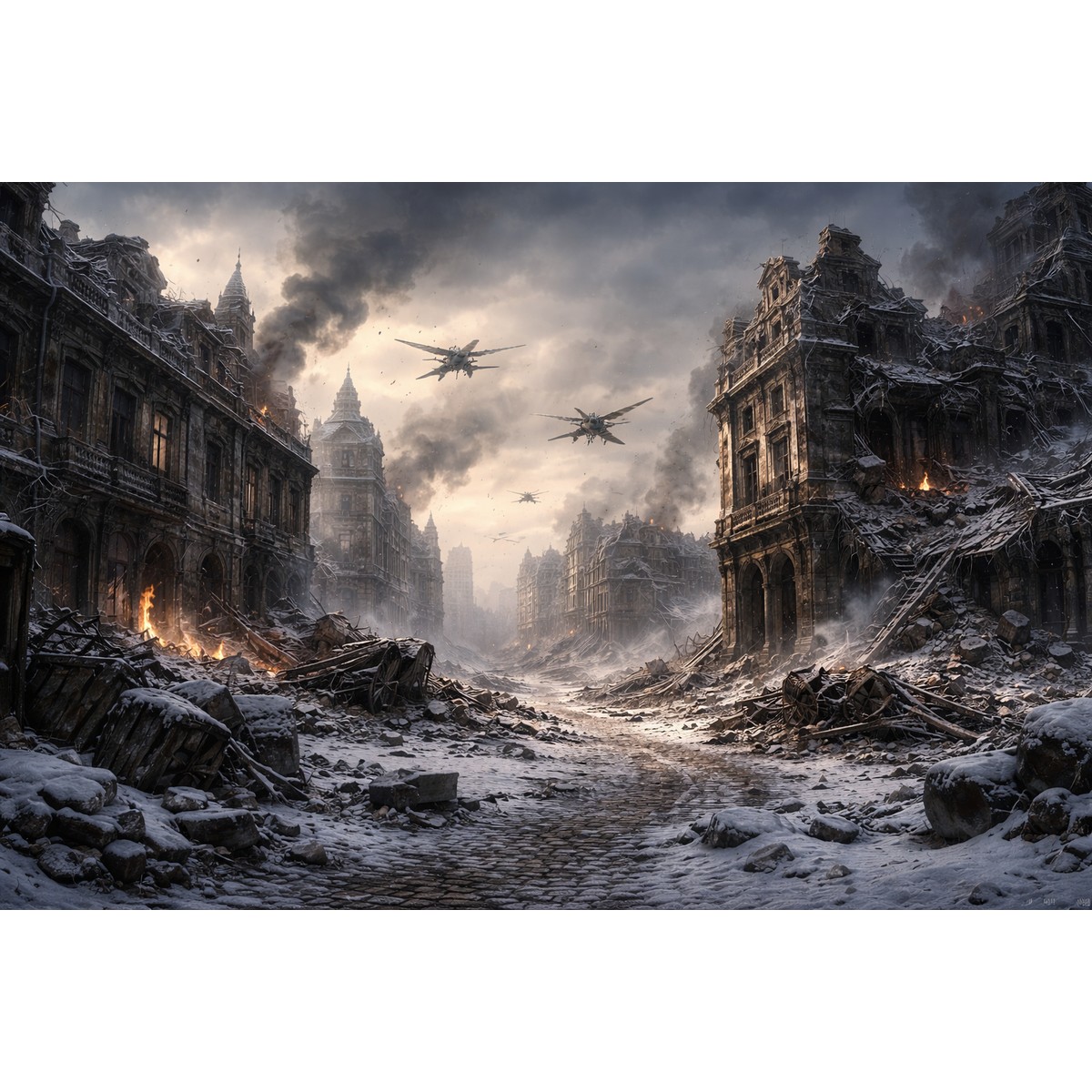
Domakha had long ceased to be a city, transforming into a bleeding wound on the body of the Rusyn Hetmanate. Ruined buildings, resembling broken skeletons, jutted out from the thick smoke and flames of fires. The city was shelled hourly by the artillery of the Moksan Khanate, destroying streets, squares, and houses, killing anyone who did not manage to take cover. Civilians flocked to the port in crowds, trying to leave this hell. Their groans and screams drowned out even the roar of artillery salvos, but we had already grown accustomed to not hearing these sounds—they had become part of our existence.
Everyone participated in the defense of Domakha: professional units, battered and exhausted in battles, the Territorial Defense, volunteer militias, among whom were old men, women, and teenagers. The front line shrank with every day. Our ration was reduced to a size barely capable of sustaining strength, but no one grumbled—the enemy stood too close, and the hatred and fear of the Moksans were too strong. To surrender meant to give up everyone still alive to be torn apart by a cruel enemy.
Every day, overloaded vessels left the port, carrying desperate people to safety. Moksan pilots in their winged machines ruthlessly attacked ships and piers, dropping bombs directly into crowds of civilians. Bodies floated in the sea; the water was stained with blood. The tragedy repeated itself again and again, yet people continued to wait for new ships, despite the risk of death from bombs or shelling. Some could not bear it and threw themselves from the piers into the icy waves, unable to wait for salvation any longer.
Our resistance was desperate. At night, Hetmanate ornithopters soared into the sky, carrying out near-suicidal sorties, delivering provisions and ammunition to the surrounded city. By day, our fighters covered the evacuation in the port. Their courage was astounding, but the losses were enormous. We often heard the crash of downed machines, but every successful mission gave us hope to hold out a little longer. The pilots returning from raids looked like ghosts—tired, emaciated, with eyes full of desperate determination and fear. Many machines, after landing, could no longer rise again, crashing during failed takeoff attempts or falling under squalls of enemy fire.
From the sea, the city's defenders were supported by monitors, several frigates, and a cruiser of the Rusyn Hetmanate.
We had no need to fear the main forces of the Moksan Khanate fleet. At the very beginning of the war, when a landing detachment was heading for Odesa, the flagship of the Khan's fleet—the battlecruiser Moksanmaa—was sent to cover it. It was the largest and most powerful ship in the entire Black Sea, the pride and favorite toy of Khan Velmes II. At night, before reaching the rendezvous point with the convoy, the battleship was suddenly attacked by Rusyn fire ships. A well-planned and executed attack from different directions, combined with the negligence of the Moksanmaa’s watch, resulted in the battlecruiser becoming a submarine.
The ship took several hits; water gushed into huge breaches, and explosions caused fires. She took on a trim by the stern, and in the bow section, flames began to creep toward the ammunition magazines. The crew fought for the ship's survivability to the last, but at 4:37, a column of fire 300 meters high shot into the sky. The glow of the flash was visible even in Odesa. The massive main caliber turret, weighing 800 tons, flew 50 meters into the air and crashed down onto the nearby destroyer Iskhan, which had approached to rescue the sailors.
That night, two landing support ships were lost. The landing itself also proved unsuccessful. Having landed at the mouth of the Tiligul Estuary, it was met by mobile Coast Guard units, and the small groups that broke through were later destroyed in the steppes by local self-defense forces.
The Hetmanate fleet's operation to support the surrounded Domakha was successful.
Small but powerful Katran-class monitors from the Azov Flotilla, under the command of brave captains, approached the shore in thick fog, almost running aground. The cruiser Sagaidachny covered the port with its anti-aircraft guns from air attacks and, constantly maneuvering, shelled coastal targets.
The crews acted with audacity bordering on madness, unleashing sudden and brutal fire upon Moksan positions. The fire was corrected by observers stationed on the hills around the city. Throughout the siege, the Moksans tried to locate and destroy them, but it was not easy. The ships' guns struck accurately at troops, forward ammunition depots, and enemy batteries, causing explosions that lit up the night sky with bright flashes.
The destroyers involved in the evacuation maneuvered quickly, evading fire, but sometimes the Moksans managed to land a fatal blow. We watched as the destroyer Sprytny began to blaze from a direct hit, turning into a bright bonfire amidst the dark waves. Then the torpedoes detonated—and the ship vanished into the cold waters. These scenes of the Rusyn sailors' heroism are forever imprinted in our memory.
The front was tightening its grip. The Moksans threw ever-new forces against us—infantry, artillery, and squadrons of assault aircraft, which were the main threat. The city's air defense was practically suppressed. Only a few batteries still held out at key positions, but the cruiser's air defense worked flawlessly. Anti-tank ditches and minefields helped us hold back enemy armored vehicles. The hulks of burnt-out Khanate machines piled up around the city.
Sometimes we launched insane counterattacks to drive the enemy back, if only for a time, and lay new minefields. But our strength was melting away. Losses among the defenders were immense. Hunger, cold, and constant fighting burned up the last reserves of human strength.
The fate of the civilians worried us most of all—evacuation did not stop for a minute, and our main goal was to hold out until the last civilian had left the doomed city.
Domakha held on, bleeding and burning in the fire. This city became our fortress, our despair, and our final trial. We knew that after Domakha, we would never be the same. Our souls would remain here forever—among the burning ruins, snow, and blood.
In the thick fog and under ceaseless fire from Moksan artillery and aviation, the city lived only thanks to the courage of the pilots of the Rusyn Hetmanate Air Corps, who created an air bridge that sustained the lives of the defenders. These raids were madness, a step beyond the rational, but they gave us a chance to hold out for at least one more day.
Every evening, when twilight deepened into total darkness, a group of heavy ornithopters would take off from a secret base in the south, breaking through to besieged Domakha. Their crews—young and desperate lads—knew perfectly well they were taking a deadly risk, but they flew anyway. The machines flew at extremely low altitudes, almost touching the treetops and roofs of houses, trying to evade Moksan air defenses.
The ornithopters carried the bare essentials: cartridges, medicine, provisions, and critical information from headquarters. On the return flight, they evacuated seriously wounded fighters who could no longer be helped on site. Every sortie was a feat: not a single machine returned without bullet holes, and some did not return at all.
I personally saw how one night, one of the ornithopters, engulfed in flames, landed in the city's central square. The pilot, covered in blood and burns, jumped out of the cockpit and immediately collapsed, losing consciousness. Soldiers rushed to extinguish the fire, unload the cargo and the wounded. The pilot was saved, but the machine burned completely.
The most terrifying was the sortie under the command of Lieutenant Voytovich. His ornithopter broke through heavy anti-aircraft battery fire but sustained serious damage while still on approach. Nevertheless, he managed to deliver critical ammunition and medicine. When the wounded Voytovich was pulled out and asked how he managed to make it, he only said quietly that he could not have done otherwise—because down there, they were waiting for his help.
These raids lasted several weeks until the Moksans strengthened their air defense to such a degree that flights became virtually impossible.
We, the defenders of Domakha, will forever remember the pilots who went to their deaths so that we could continue fighting. Their deed became part of the legend, part of our common struggle for freedom and the right to remain human—even in the most terrible conditions of war.
Finally, the last ship with refugees departed from the pier.
Command attempted a desperate breakout to link up with our troops in the west. The offensive was supported by the last remaining armored locomobiles, which had miraculously survived previous battles. In bad weather, under rain and snow, we unexpectedly attacked enemy positions and even occupied their camp. But the Moksan response was not long in coming: they unleashed all their anger and artillery might upon us.
We were saved only by the timely intervention of the monitors, which came as close to the shore as possible and, with precise fire, forced the enemy to halt their counteroffensive. We retreated into Domakha along a road we ourselves had mined, losing men and the last of our equipment. Many fighters fell on the return journey, covering the retreat of the main forces.
Every step back was a step toward survival. In the city, we took up defensive positions again, regrouping before the next attack.
Strength was running out, food was almost gone. Gloom seized us, but the brigade chief of staff read us an order obliging us to hold the defense until the arrival of the transport Hadzhibey and the landing ship Akkerman, which were supposed to evacuate us.
The battle continued. The remnants of the garrison snapped back with fire, and the enemy did not yet dare to enter the city. If not for the naval artillery fire, we would have perished already. No one even thought of leaving their combat post—we clearly understood that if Domakha fell, we were done for. Everyone who could stand on their feet returned to their positions, clutching weapons like a last hope.
Our positions in the frozen earth still held—like the last island of courage amidst an ocean of fear and despair. But the promised ships did not return. Had we been abandoned? Were all our sacrifices in vain? Could this really be the end?
The next night, a ghost ship appeared from the fog at the pier. It was the transport Hadzhibey. The crowd, desperate and maddened by fear, rushed toward it. People pushed, fell, got up, and ran forward again, striving to occupy even one spot on board. No one listened to orders: officers and soldiers mixed in a single drive to survive. But it soon became clear that the ship had not come for us, but for the remaining civilians—the city administration and the construction engineers who had helped organize the defenses.
The crowd froze in shocked silence, listening to the calm voice of the captain, which sounded as if from another world. The last civilians and a large number of seriously wounded were loaded onto the vessel. The rest watched them go, feeling only emptiness and despair.
Our platoon was sent to the northern outskirts of the city, where the terrain was cut by hills and fortified with dugouts. These fortifications were the last line of defense, and holding them became our main task. The Moksans sent their snipers here, who constantly watched our positions, striking unexpected blows.
The scanty remnants of the defenders barely held on to these positions. There was no longer any talk of battalions or combat groups—anyone who could stand and hold a weapon fought. Trenches dug by engineers with heavy machinery now became the soldiers' last refuge. The enemy was constantly approaching, and we lost men every night. A young volunteer died right before my eyes, quietly and unnoticed, shot by a sniper. Another fighter suddenly stood up and, as if hypnotized, simply walked into the darkness under shell bursts.
At dawn, the city was illuminated by dying fires, and we realized that the Moksans could have taken us without a fight. But for unknown reasons, they waited—apparently, they did not yet have the order. Moksans love various dates very much, and it seems the capture of Domakha was supposed to be a gift for the Khan's birthday.
By noon, when we ran out of ammunition, our commander decided to return to the city, and we followed him. But halfway there, our strength finally left us, and we simply collapsed onto the ground, no longer able to go any further. Echoes of fighting came from the east, but we had neither the strength nor the desire to move or do anything.

Night again brought fog and darkness. Time had lost all meaning for us. Suddenly, the sound of a steam engine came from the sea, and then—voices. We jumped up, listening. A shout rang out in the thick fog:
"Akkerman is here!"
Everyone ran to the water, shouting back. The silhouette of a ship emerged from the fog. We threw ourselves into the water, and sailors threw us ropes and lowered nets from the sides, helping us climb onto the ship. I had almost lost consciousness from the cold and exhaustion when strong hands pulled me onto the deck. We were given dry blankets and hot tea with alcohol, which burned our insides and brought us back to life.
As the ship pulled away from the shore, the city continued to burn, and I watched the glow—as if saying goodbye to myself and my past life. The vessel delivered us to the safe port of Ochakov, where refugees and hundreds of wounded were already awaiting their future fate. I was saved, but many trials still lay ahead. The war was far from over, but now we had hope of survival once again.
PLEASE ENCOURAGE AUTHOR BELOW LEAVE COMMENT ON ARTICLE AS A MEMBER OR VISITOR
This article has been read 43 times < Previous | Next >
Free Reprints
Main Site Articles
Most Read Articles
Highly Acclaimed Challenge Articles.
New Release Christian Books for Free for a Simple Review.
God is Not Against You - He Came on an All Out Rescue Mission to Save You
...in Christ God was reconciling the world to himself, not counting their trespasses against them... 2 Cor 5:19
Therefore, my friends, I want you to know that through Jesus the forgiveness of sins is proclaimed to you. Acts 13:38
LEARN & TRUST JESUS HERE
FaithWriters offers Christian reading material for Christian readers. We offer Christian articles, Christian fiction, Christian non-fiction, Christian Bible studies, Christian poems, Christian articles for sale, free use Christian articles, Christian living articles, New Covenant Christian Bible Studies, Christian magazine articles and new Christian articles. We write for Jesus about God, the Bible, salvation, prayer and the word of God.