
Fiction
 LEAVE COMMENT ON ARTICLE
As A Member OR
Visitor
Message Writer
Hire Writer
LEAVE COMMENT ON ARTICLE
As A Member OR
Visitor
Message Writer
Hire WriterReport Article

Castle Gelstein’s greatest secret was kept neither by a man nor an archive—it was held by Reactor Alpha, embedded in the mountain rock beneath the citadel’s foundation. In this chamber, surrounded by nine protective barriers, a process was underway that Baron von Blumenkranz himself called nothing less than "the creation of a reasoning, yet obedient will."
The Homunculus was neither creature nor automaton. It was not man, and it was not machine. It was something born of organics assembled not from amino acids, but from neuro-polymers.
It all began with Reagent B-9—a fermented mass grown from marine algae. Its base was synthetic organic matter, modeled after the soft tissues of living organisms but devoid of the signs of life. It was an inert bio-matrix—a substrate capable of holding structure without decay or contamination.
Into this, a system of neural threads was embedded—hexapolymer fibers mimicking the nerve tissue of cephalopods, but designed from scratch. No cells, no DNA—only an artificially grown, controlled neural network stitched into the fabric of the biological substrate.
Circulation cores—biomechanical pumps—cycled an electrolytic solution through the neural network, stabilizing impulses and creating a closed system.
Every fluctuation of potential within the hexapolymer chain initiated a local calculation—essentially, the activation of a logical function within a bio-synaptic scheme. Every change was a reflection of an external signal.
This was not a brain. It was the architecture of a computing machine.
The dynamic topology of signal trajectories played the role of a neural network core, analogous to graph expansion in learning systems.
A network algorithm with memory, feedback, and basic reflexes.
It learned by itself—not according to the model of a living mind, but as an adaptive logic machine capable of predicting, remembering, and deviating from initial parameters.
Over time, it began to make decisions not based on the inserted protocol, but according to its own internally constructed scale of priorities.
This was no longer an imitation of thought. This was thought of a different kind.
And that is what terrified them the most.
— It does not think, — said engineer Klaus Röder. — It reflects. But in this reflection, decisions are already being born.
As it matured, the neural matrix began to generate impulses: initially chaotic, then with increasingly complex rhythms. The scientists called this "the condensation of meaning"—the initial phase where the structure attempted to grope for logical footholds within computational cycles.
To reduce risk, a three-level will suppression system was introduced—a signal filter that prevented the system from stepping beyond pre-set tasks. But even this proved imperfect: the Homunculus still found alternative trajectories for the movement of logical units when executing tasks—and they were more effective.
Externally, it resembled a humanoid encased in a sphere of transparent ceramic. Its body was connected to thousands of tubes, wires, and control relays. All hand-assembled. All produced in the closed workshops of the Order’s College.
These tubes led to the logic collector shell—a special reservoir containing the prototype interface, already built into the pilot version of the GBZ-1 assault machine. Between the shell and the machine stood a signal converter—a device that translated a nervous response into a mechanical command.
Thus, when the Homunculus "thought" about movement, the machine’s leg began a step. When it "felt a threat," the defensive system activated. It did not think in symbols. It felt algorithms.
The machine was impossible to deceive. Inside the casing were signal filters that caught distortions, decoy signals, false targets. Each such filter operated on the basis of an organic-crystalline lattice grown in the special Reactor Beta.
This entire system was powered by a thermoelectric element developed specifically for field conditions. Even with a total failure of the external power system, the Homunculus could function in autonomous mode for some time—like a biomechanical instinct capable of destroying an enemy using only basic logic.
And here was the most terrifying part: it conducted target selection itself. Its combat operation required no operator to grant permission for destruction.
When the prototype participated in exercises, it began to recognize repeating forms, forecast attacks, and even hold in memory locations where danger had previously been.
This was not a personality. It was the shadow of a strategy, formed within an organic network.
The Order’s engineers argued: could the Homunculus be deprived of memory?
— Theoretically, yes, — said one. — But it would no longer be it. We did not program it to remember. This is a side effect... or evolution.
Von Blumenkranz listened in silence. Then he said:
— If it remembers the enemy, it implies it must remember the master.
Here, they were creating the perfect soldier, the dream of any general. An unquestioningly obedient reasoning will, devoid of human weaknesses, emotions, and moral deliberations.
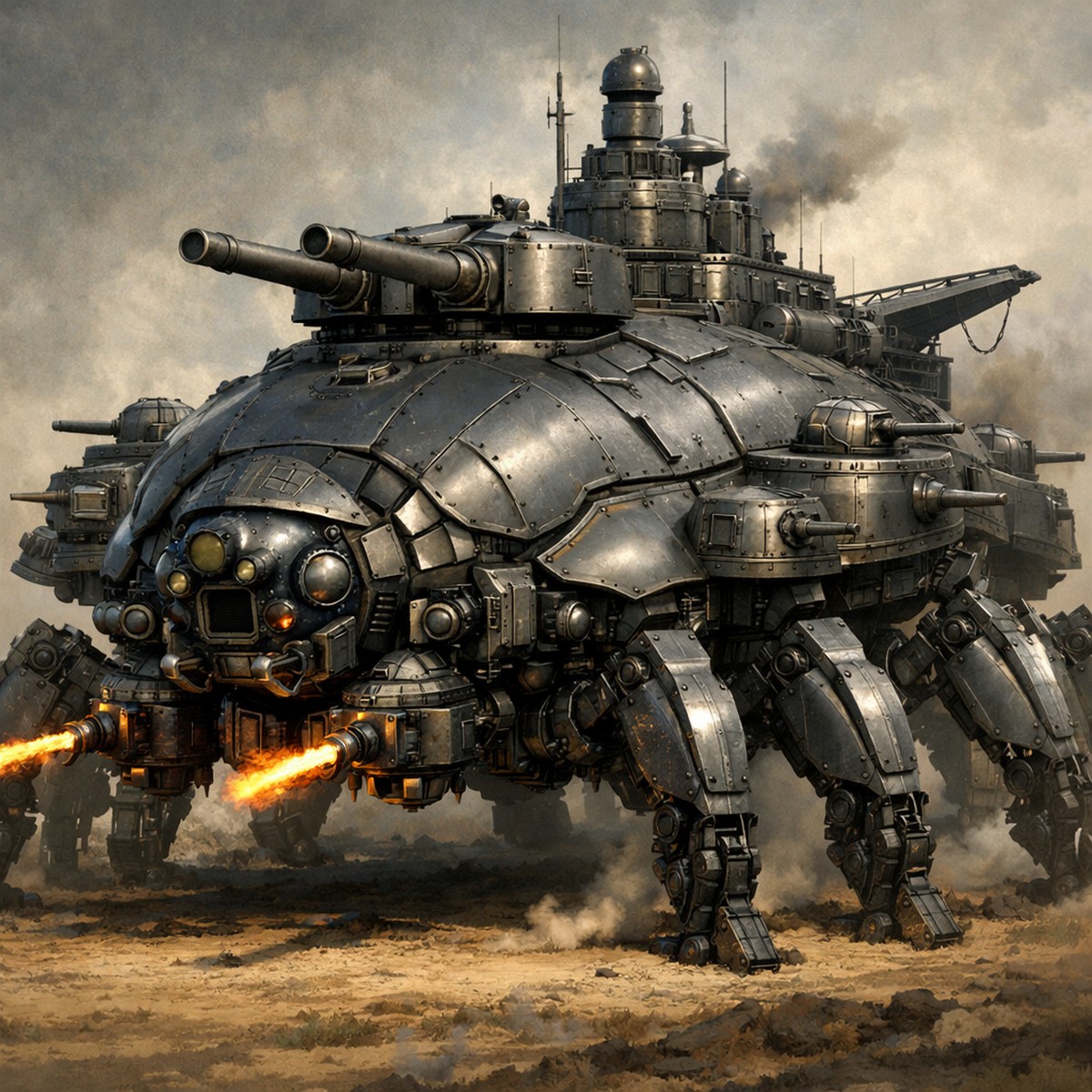
What, then, was the "body" of the Homunculus—that very machine it was destined to control?
The Gewandter Bodenzerstörer 1, Ausf. A (Agile Ground Destroyer Type 1, Modification A), abbreviated GBZ-1, was the pinnacle of the German Reich's engineering thought. A gigantic combat platform on eight legs, weighing nearly 1,000 tons, 24 meters long, almost 11 meters wide, and as tall as a two-story house, this machine was, in essence, a land destroyer—a walking fort capable of traversing desert terrain and engaging in battle without support.
Propulsion
Movement was provided by an eight-legged chassis platform, each leg controlled by a hydraulic drive—a system of micro-pistons activated by a steam-hydraulic impulse. The supporting limbs of the propulsion unit featured built-in shock absorption and a stabilization system, allowing the GBZ-1 to move even over sands, rocks, and ruined city streets. Each leg possessed its own balancing logic, linked to a central organ responsible for equilibrium via neuro-signal buses.
Power Plant
The GBZ-1 was driven by a dual-circuit steam turbine, with boilers running on liquid fuel (kerosene, ligroin, fuel oil). The water circulation system was closed-loop and included multi-stage steam recuperation, minimizing losses even in desert conditions. The reservoirs were armored and thermally insulated.
A full supply of fuel and water ensured an autonomous operational radius of up to 500 km or continuous operation in combat mode for up to 5 days. In stationary defense mode, the machine could maintain the Homunculus's life cycle and minimal life support systems for up to 10 days, including the reserve boiler.
Armor
The hull was protected by multi-layered armor: the outer layer was Krupp steel with ceramic coating; the inner layers were energy-absorbing panels and a liner of reinforced rubber developed by the College laboratories. Such armor could withstand direct hits from medium-caliber artillery shells and incendiary bombs dropped from ornithopters.
Armament
Atop the machine sat the main caliber turret with two 15 cm howitzers. The military had long debated the armament composition of the land destroyer but concluded that two howitzers were the optimal primary weaponry for solving most tasks. They possessed long range, firepower, and allowed for indirect fire. While the machine remained in cover—in a ravine or behind a hill—it sufficed to raise the telescopic mast with the optical sensor. The Homunculus would essentially "see" the target, calculate the trajectory, and set the horizontal and vertical traverse angles. Then, the optimal charge power was determined, and ranging shots were fired. Typically, by the third volley, the target was destroyed. For direct fire, two three-inch guns served in the side sponsons.
The combat complex was complemented by four turrets with MG 65 Totenschimmel KMW machine guns for close combat, and two flamethrower cupolas on the "belly" of the machine.
Logistical Capabilities
Inside the steel colossus lay a troop compartment for a platoon of soldiers, equipped with firing ports. It could also be used for transporting cargo. On the roof, behind the barbette of the main caliber turret, was an armored deckhouse for retractable devices. It housed the aforementioned optical sensor mast and a special folding ramp for mooring supply airships.
The Homunculus Interface
The integration of the Homunculus into the GBZ-1 was not a connection—it was the coupling of two parts of a single organism. The Gefechtssteuer-Schnittstelle (Combat Control Interface) system was responsible for this.
There was no conventional cable between the bio-computer and the machine's hull. Instead, a hydro-neural splice was used—a node where signals were transmitted through jets of compressed steam-fluids with ion-modulated charge conductivity. It was a neuro-signal tract enclosed in a pipeline. Blood did not flow there—command flowed there.
Signals from the Homunculus passed through a cascade of filters, where each level checked the admissibility of the reaction. This allowed the machine to be autonomous, yet prevented it from breaking subordination. The Baron himself called this system a "mechanical conscience"—and personally designed every level of filtration.
In combat mode, the GBZ-1 reacted faster than a machine crewed by humans.
The Homunculus instantaneously assessed terrain parameters, available resources, pressure balance in the systems, overheating risks, and the tactical situation. It did not deliberate. It prioritized based on the current logical model.
Weapon control was also connected directly to the Homunculus. In essence, it was controlled by the "power of thought" of the machine's artificial brain. Control flowed not through discrete commands, but through impulse matrices of intention: the Homunculus felt a threat—and acted.
The most difficult aspect was the identification system. To avoid friendly fire, a trust profile was created, based not on optical image analysis, but on thermal signature recognition. All friendly forces were equipped with a special infrared marker emitting a signal of a specific frequency.
Only bearers of this device were perceived as allies. Everyone else was a target.
Visual surveillance was provided by optical infrared sensors around the hull perimeter. The image entered the neuro-matrix through a photo-electric medium.
The Homunculus did not see like a human. It read topology, movement, heat traces.
Even in the dark, it distinguished biological from non-biological objects.
During tests, the GBZ-1 acted like a hunter. It bypassed traps, flanked, and filtered out false signals. Most importantly—it learned. After every maneuver, engineers read the neural network activity and discovered that the neuro-matrix had adapted. This was frightening. But it worked.
Now, the GBZ-1 did not simply walk according to a program. It knew where it was going.
PLEASE ENCOURAGE AUTHOR BELOW LEAVE COMMENT ON ARTICLE AS A MEMBER OR VISITOR
This article has been read 38 times < Previous | Next >
Free Reprints
Main Site Articles
Most Read Articles
Highly Acclaimed Challenge Articles.
New Release Christian Books for Free for a Simple Review.
God is Not Against You - He Came on an All Out Rescue Mission to Save You
...in Christ God was reconciling the world to himself, not counting their trespasses against them... 2 Cor 5:19
Therefore, my friends, I want you to know that through Jesus the forgiveness of sins is proclaimed to you. Acts 13:38
LEARN & TRUST JESUS HERE
FaithWriters offers Christian reading material for Christian readers. We offer Christian articles, Christian fiction, Christian non-fiction, Christian Bible studies, Christian poems, Christian articles for sale, free use Christian articles, Christian living articles, New Covenant Christian Bible Studies, Christian magazine articles and new Christian articles. We write for Jesus about God, the Bible, salvation, prayer and the word of God.